-
The 53rd Pan Music Festival Concert V
- Date 2025-10-31(Fri)
- Time19:30
- Venue Recital Hall
- AdmissionFor elementary school students and up
- Running Time (min.)90
- PriceGeneral seats 30,000won
- HostPan Music Festival
- ManagementContemporary Culture
- SupportARKO
- SponsoredInstitut Francais, GOETHE Institut/ 협력 Ircam, Studio2021, SPEDIDAM
- Inquiry02-2266-1307
#PanMusic #Fabrik #Quartet #newmusic #contemporary


 > 공연/전시 > 진행·예정 프로그램

- ※ Age Restriction Notice
If proof of age cannot be provided, entry will not be permitted regardless of ticket possession or accompaniment by a guardian.
- Elementary school age and above: Born before 2019 (including those born in 2019) or elementary school students and above are permitted entry.
- Middle school age and above: Born before 2013 (including those born in 2013) or middle school students and above are permitted entry.
※ Ticket Purchase Guide (→)
※ If there is no event description in English, the page is available only in Korean.
In this case, please click the 국 button
 at the upper-right of the page.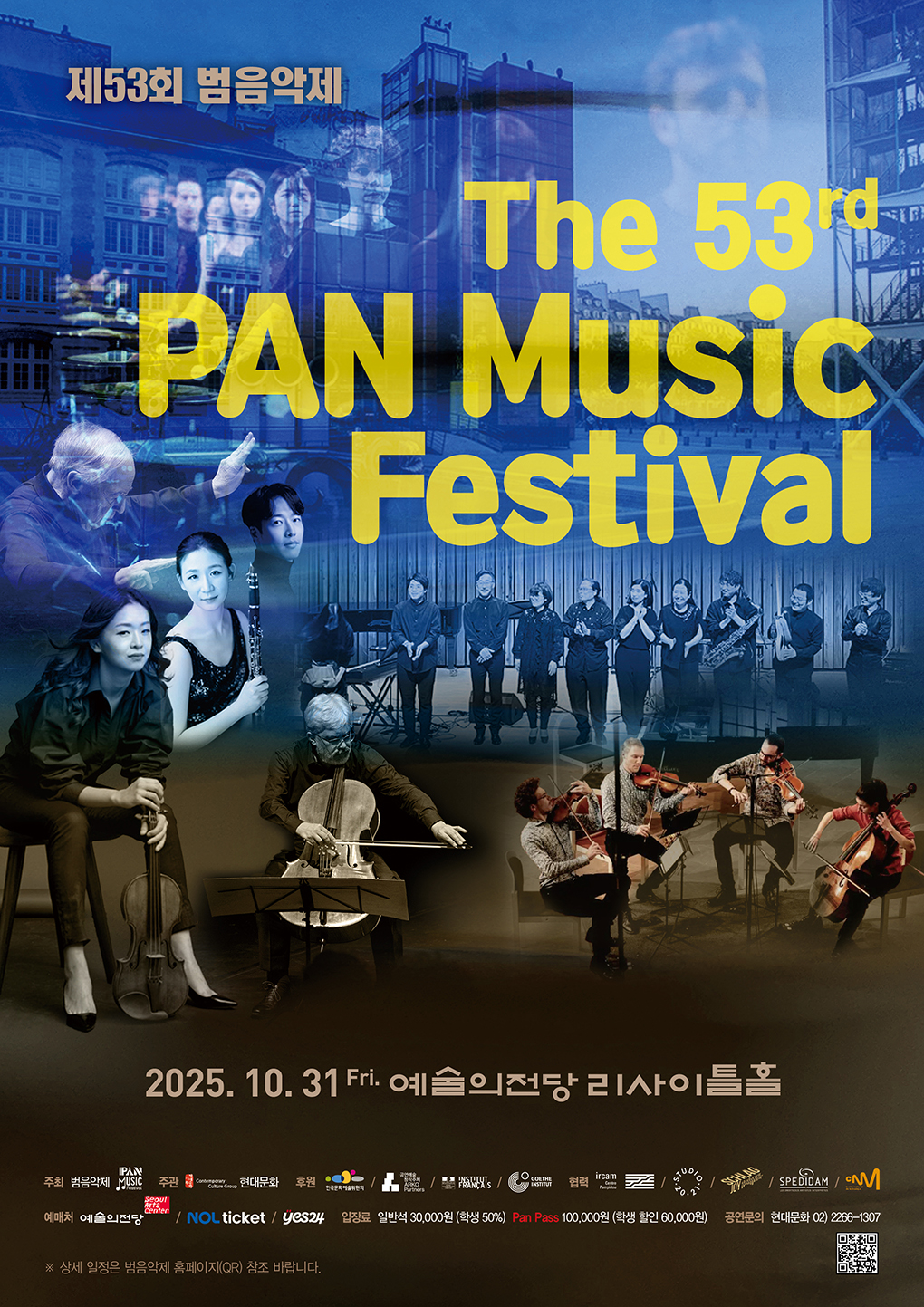
[PROGRAM]
So-Min Lee "Der Weltschmerz" (2025)
Areum Lee "Staub" (2023)
Chi-Chun Chisun Lee "String Quartet No. 5 Chromesthesia" (2025)
Hector Parra "Un concertino di angeli contro le pareti del mio cranio"
John Cage "Quartet in four parts"
[Composer Profile and Program Note]
So-Min Lee
- Currently a third-year student in the Department of Composition at Hanyang University
- Excellent performance in the first semester of 2024 at Hanyang University
"Der Weltschmerz" (2025)
We encounter countless events throughout our lives—some manageable, others overwhelming. While we may hope to overcome every challenge, reality often presents us with situations that lie beyond the scope of individual control. In such moments, what thoughts and emotions arise?
The German term Weltschmerzencapsulates a particular emotional state: the sorrow and disilusionment felt when the world’s harsh realities conflict with personal ideals. It refers to a deep, existential grief—a response to witnessing violence, contradiction, and injustice, and to recognizing that the world can never fuly align with our hopes or values. This term speaks to the pain rooted in the awareness of life’s transience, imperfections, and the irreconcilable gap between the ideal and the real.
In the face of a merciless and indifferent world, we often experience helplessness. The realization that we are unable to resist or change the course of such a reality can lead to a profound internal ache. This sense of powerlessness, and the emotional turmoil that folows, forms the basis of the sound world explored in this piece.
Here, unstable emotional states are represented through glissandi between microtones and trembling textures, while intense dynamics and harsh noise elements convey the rawness of inner suffering. Yet, emotional closure does not always folow the end of an event. Residual tension lingers. Techniques such as circular bowing and sudden bursts of noise reflect this persistent unease, while irregular rhythms and cyclical motifs portray a psyche stil gripped by confusion and instability.
Caught between ideals and reality, we continue to live through the in-between. The pain that seeps into that space may be an inevitable part of human experience—a quiet yet enduring passage shared by many.
This work seeks to give form to that passage, translating intangible emotion into sound
Areum Lee, composer
Composer Areum Lee creates works that are intuitive and spiritually resonant, often inspired by the metaphysical aspects of everyday life and the latent energy embedded in language. She is particularly drawn to exploring the invisible through multiple sensory dimensions, frequently incorporating theatrical elements and electronic media into her music.
Her works have been performed at several festivals including the Pan Music Festival, Tongyeong International Music Festival, Daegu Contemporary Music Festival, as well as international festivals such as Bludenzer Tage zeitgemäßer Musik and Biennale für Neue Musik Graubünden. She has also served as composer-in-residence in Lauenburg and Eckernförde, Germany.
Lee holds a Bachelor's degree in composition from Hanyang University, a Master's degree from the University of the Arts Bremen, and completed the Exzellenz Komposition at the Robert Schumann Hochschule Düsseldorf. She has received scholarships from various German federal states and arts foundations, and continues to actively present her work across Europe and Korea.
She is currently active as a composer with the project ensembles morph and New Music-Da.
"Staub" (2023)
Walking. On a stroll. Birds chirping. My footsteps. Dragging my shoes through sand. A train whistle in the distance. A sudden flutter. Just the sound of air. The empty sky. Thoughts.
That humans return to the earth,
that when everything is broken, crushed, shaken off,
my physical being leaves not even a breath.
Carried away by the wind, disappearing.
That disappearance, that emptiness—
I choose to accept it humbly.
I watch my vanishing,
quietly,
sometimes fiercely,
I watch my life.
From earth I came,
to earth I return.
Chi-Chun Chisun Lee, composer
CHIHCHUN CHI-SUN LEE’s works were described as “eye-openingly, befittingly, complex, but rather arresting to hear” (Boston Globe), “exploring a variety of offbeat textures and unusual techniques” (Gramophone) and “eastern techniques blended with sophisticated modern writing style” (Amadeus).
Chihchun Chi-sun Lee received honors from Guggenheim Fellowship, Brandenburg Symphony Int. Competition, MARCO Competition, Global Music Award, IAWM’s Theodore Front Prize and ISCM/ League of Composers Competition, and commissions from Boston Symphony Orchestra, Harvard Fromm Foundation, Barlow Endowment; National Culture and Arts Foundation, NSO, NCO (Taiwan); & National Orchestra of Korea. Her music has been performed at Carnegie Hall, the 2010 Winter Olympics in Vancouver, UNESCO International Rostrum of Composers, and various international festivals and broadcasts worldwide.
Chromesthesia聲織韻境(Sound-Weaving Resonant Realm)
Chromesthesiais a sensory exploration of sound and color — a sonic interpretation of a condition where tones evoke hues, textures, and spatial impressions. Each movement acts as a fragment of an imagined chromesthetic world, where music is not only heard, but seen and felt.
I. Whisper in Pale Blue
A gentle breeze of tones drifts through a translucent blue space. This movement captures the intangible — sound as vapor, as breath, as air shifting quietly through light.
II. Silver Veins
Swaying, gliding lines flow like mercury. Glissandos stretch and blur the edges of form, tracing delicate veins of sound through a reflective surface.
III. Vibrant Prism
A heartbeat pulses beneath fractured color.
This movement radiates with dance-like energy — a sonic prism that splits rhythm and tone into kaleidoscopic flashes. Percussive, bold, and saturated with motion, Vibrant Prismspins with light-infused momentum, where each beat casts a new hue across the soundscape.
IV. Polka of Frickerpoint
In a surreal landscape of flickering pulses and dotted rhythms, a mechanical dance unfolds. “Frickerpoint” is a fictional realm where rhythm becomes light, and light becomes play. The polka form is twisted, playful, and slightly absurd — a clockwork ballet of sonic sparks.
V. Geometry of Tone
Here, pitch becomes architecture. Notes are placed like crystalline structures, forming invisible patterns in space. Abstract and precise, this movement is a meditation on the shape of sound.
Hector Parra, composer
Hèctor Parra (Barcelona on 1976) is pensionnaire at the French Academy in Rome / Villa Medici 2021-22.
He has studied composition with David Padrós and Carles Guinovart at the Barcelona Conservatorium, with Jonathan Harvey, Brian Ferneyhough and Philippe Manoury at Ircam in Paris as well as with Michael Jarrell in the Haute École de Musique of Geneva. He has the Master in Arts of the Paris-VIII University with honours. He has been Professor of Electroacoustic Composition at the Conservatory of Music of Zaragoza, in Spain, and from 2013 to 2017 he has taught composition at Ircam-Centre Pompidou.
Premieres of his works have been performed by the Ensemble Intercontemporain, the Klangforum Wien, Ensemble Modern, Musikfabrik, Ensembe Recherche, the Arditti Quartet, the Gürzenich Orchester Köln, the Tokyo Philharmonic Orchestra, Brussels Philharmonic, BBC Scottish Symphony Orchestra, Radio Sinfonieorchester Stuttgart, Freiburger Barockorchester, Concerto Köln, Barcelona National Orchestra, Spain National Orchestra, among others.
He received commissions from the French state, the Flemish Opera House, the Nürnberg Opera House, the Teatro Real Madrid, the Ircam-Centre Pompidou, the Berlin Academy of Arts, the Strasbourg Musica Festival, Musée du Louvre, WDR, SWR, Kölner Philharmonie, Mécénat Musical Société Générale and the Selmer Society, among others. His works are premiered at the international festivals of Lucerne, Warsaw Autumn, Wien Modern, Paris Philharmonie, Donaueschingen, Ircam Manifeste, Witten, Stuttgart Opera House, Bacelona Opera Liceu, Guggenheim NY, San Francisco Arts Festival, Vienna Konzerthaus, etc.
He has composed nine operas and music theatre works in close collaboration with writers such as Marie NDiaye, Händl Klaus or Fiston Mwanza Mujila, that has been staged by Caixto Bieito, Rebecca Ringst, Vera Nemirova, Georges Lavaudant, Matthew Ritchie, Benjamin Schad and Robert Pienz at the Geneva Grand Theatre 2024, Gran Teatre del Liceu 2024, Antwerp Opera House 2019, Berlin Staatsoper 2016, Schwetzinger SWR Festspiele 2015, Münchener Biennale 2014, Theater Freiburg 2014, Théâtre des Bouffes du Nord 2014, Festival Musica Strasbourg 2014, Sophiensaele Berlin and Basel Gare du Nord 2013, Gran Teatre del Liceu 2010, Luxemburg Philharmonie 2010, Kaaitheater Bruxelles 2010, Centre Pompidou 2009, Opera de Hoy 2007, Madrid.
Since the world premiere of his latest opera Les Bienveillantes, based on Jonathan Littell's eponymous novel, on a libretto by Händl Klaus and staged by Calixto Bieito, the international press has never stopped greeting the event: "The most important opera of the 21st century" La Vanguardia, "A grandiose and challenging score" BRF Nachrichten, "A highly expressive music, masterfully orchestrated" Neue Zürcher Zeitung, "A colossal score, of great dramatic force" El Mundo, "Immensely powerful, extremely cleverly built" Deutschlandfunk, "A limit experience" Crescendo Magazine. His opera Das geopferte Leben, 2014 was nominated by the prestigious German magazine Opernwelt "one of the premieres of the year", and his but last opera, Wilde, has been qualified as "a masterpiece" by the newspaper Süddeutsche Zeitung and the specialized magazine Das Opernglas.
Un concertino di angeli contro le pareti del mio cranio (2021)
Dedicated to the memory of Robert Gerhard (for the fiftieth anniversary of his death in 2020), this work "signifies", as always in the repertoire of this composer, resident at the Villa Medicis in Rome since last summer:
"We live in a time of intense political uncertainty. But Pier Paolo Pasolini, already in the 60s had denounced with great insight the way in which fascism survives and annihilates all traces of humanity in modern society through the culture of consumption. By showing the horror of a society which, under the powerful impulse of homogeny, seeks to erase from the map those who feel trapped under the wheels of history.
This was the case with many artists and intellectuals who had actively collaborated at the end of the 1930s with the Second Spanish Republic and with the Catalan government. Robert Gerhard was undoubtedly the greatest representative in exile of Catalan musical creation, and, with the composition of this string quartet, I would like pay him my most humble and sincere tribute.
This new string quartet explores the oppositions between homophony and polyphony, platitude, and roughness, modernity and archaism, which are inspired by dualities so close to Pasolini’s heart: past/present, death/sex, ancestral society/modern life. In my quartet they are confronted with the mysterious emergence of a traditional Catalan song with atavistic colours - El cotiló-, very dear to Robert Gerhard throughout his thirty-year exile in the United Kingdom, an exile that lasted until his death. As Pasolini wrote in Empirismo eretico, “an author can only be a stranger in a hostile land: in reality, he dwells in death rather than inhabiting life, and the feeling he provokes is a feeling, more or less strong, of racial hatred.”
John Cage, composer
Born in Los Angeles (USA) on 5 September 1912, John Cage was a musician, writer, painter, mycologist, and thinker, who crafted his life as an ongoing process and lived outside all categorization.
His first contact with music was through the piano lessons he took as a child. Later, in 1930, bored with an education based on repetition and uniformity, he set sail for Europe looking for new experiences. Returning to California the following year, he began studying composition with Richard Buhlig and Henry Cowell, and then undertook private lessons with Adolph Weiss. In 1935 he married Xenia Andreyevna Kashevaroff, from whom he separated ten years later. From 1934 to 1936 he studied analysis, composition, harmony, and counterpoint with Arnold Schoenberg, which gave him occasion to understand how little inclined to harmonic thinking he was. From 1938 to 1940, he worked at Cornish College of the Arts in Seattle, where he met Merce Cunningham, who would become his companion and collaborator. It was during this period that he wrote his manifesto on music, “The Future of Music: Credo” invented the water gong and the prepared piano, and composed Imaginary Landscape No.1 (1939), one of the first works of music to use electronics.
The 1940s marked a turning point for Cage after these early, formative years in which voice and percussion were his instruments of choice. In New York, he participated in a concert at the MoMA during which his composition Amores (1943) was premiered; he met Indian musician Gita Sarabhai and began reading the work of Ananda K. Coomaraswamy and Meister Eckhart. In 1948, he completed Sonatas and interludes, the fruit of several years’ worth of experimentation with prepared piano. In 1949, he returned to Paris, where he worked on the music of Erik Satie and encountered such composers as Olivier Messiaen, Pierre Schaeffer, and Pierre Boulez. He and Boulez maintained an extensive correspondence that lasted until 1954.
Returning to New York in 1950, Cage became involved in what would come to be known as the New York School, which included Morton Feldman and Christian Wolff, joined by Earle Brown in 1952. His friendships with painters in this circle, particularly Robert Rauschenberg, were also significant during this time, as may be observed in his silent piece 4’33’’ (1952). His Music of Changes (1951) and Untitled Event (1952) marked the birth of the musical happening. Water music (1952) explores unconventional notation. The Merce Cunningham Dance Company was founded in 1953, with Cage as its musical director, a position he would hold until his death. His collaboration with Cunningham was one in which music and dance coexisted equally, without relationships of dominance and subordination between them. During this time, Cage also attended lectures on Zen Buddhism by Daisetz T. Suzuki and began working chance operations and free choice into his music: he first used the I Ching in the third movement of Concerto for Prepared Piano and Chamber Orchestra (1957-1958).
His lecture “Composition as Process” at the Darmstadt Summer Course in 1958, and his indeterminate music, including Variations I, sparked widespread debate among the European avant-garde. In 1961, he published Silence: Lectures and Writings, and by 1962 his understanding of music as theatre was beginning to take shape, with the premiere of 0’00’’ (4’33’’ nº 2). Variations V andVII, Musicircus (1967), HPSCHD with Lejaren Hiller, the electronic music/chess performance Reunion (1968) with Marcel Duchamp and Teeny Duchamp, were all major events in the evolution of multimedia and environmental sound art. Song Books, published in 1970, was a collection of a wide variety of compositional processes and types of notation with texts by Cage and authors he admired such as Buckminster Fuller, Marshall McLuhan, and, most prominently, Henry David Thoreau. The social aspect of his work began to emerge in the project Freeman Etudes for violin (1980; 1990).
John Cage’s career as a visual artist began with an exhibit of his scores in 1958 at the Stable Gallery; despite regular appearances in the visual arts world, it was only with the etchings created at Crown Point Press on invitation from Kathan Brown that this practice became a central one for Cage. At the time of his death, he had produced some 900 etchings, watercolors, and drawings. In these works – as in the mesostics he began writing after composing Empty Words in 1976 – Cage worked along the same principles as he did in his music, as may be observed in Where R=Ryoanji (1983-1992), for example. Between 1987 and 1991, he composed Europeras I-V, and between 1987 and 1992, the cycle Number Pieces, where he made use of what he called “time-bracket notation.” In this period, Cage explored forms of automatic or computer-assisted writing based on programs created by his assistant Andrew Culver. He received many major awards and honors in the last years of his life, including the Kyoto Prize (1989) – a life devoted to experimentation and freedom.
Quartet in Four Parts (1950)
A seminal piece by American avant-garde pioneer John Cage, this quartet marks a turning point in his compositional style. The work features a strict rhythmic structure, a limited set of sounds used without transposition, and strings played without vibrato, avoiding traditional self-expression in favor of an unfolding, cyclic structure. Cage restricts the notes and chords to a small collection of sonorities (gamuts) that are used always in the same way, never transposed, fragmented, or arpeggiated, creating a simple and focused sound world.
This work consists of four movements: Quietly flowing along - Slowly rocking - Nearly stationary - Quodlibet. The rhythmic structure is an unvarying 2 1/2, 1 1/2, 2, 3, 6, 5, 1/2, 1 1/2, for a total of 22 units of 22 measures each. It is a work of great simplicity, reminiscent of Erik Satie and in a way a further step toward Cage’s abandonment of self-expression. As in his Sonatas and Interludes, it deals with the nine permanent emotions of Indian philosophy (see Sonatas and Interludes), as well as the Indian notion of the seasons, i.e. creation, preservation, destruction, and quiescence. In the first movement, the subject is Summer in France, in the second it is Fall in America. The third movement is about Winter, and the fourth, about Spring, is a welcome and quite sprightly quodlibet
The 53rd PAN Music Festival 2025
Artists
FABRIK QUARTET
The Frankfurt based Fabrik Quartet emerges for its committed, fresh and audacious interpretation of contemporary music. The four members cultivate curiosity and full-time dedication for the string quartet medium, and are equally-minded in the intent of embracing the full potential of nowadays music languages.
Since its creation, the Fabrik Quartet has garnered awards and support for their performances. The Quartet was awarded first prizes at the International Chamber Music Competition "A. Rubinstein" 2022 in Düsseldorf, the Third International Contemporary Music Competition Re_Crea in Castelló, Spain, and the Polytechnischer Competition at the Frankfurt Hochschule für Musik; in 2024 the quartet won 2nd prize and special prize in the &John Cage Award& in Halberstadt. As a recipient of the Kamar Percy und Ingeborg John-Stiftung award the Quartet recorded its first CD with the label &Bad Homburger Schlosskonzerte&.
The Quartet was one of three ensembles selected for the InSzene program through Podium Gegenwart of the Deutscher Musikrat, and is currently part of the String Quartet program promoted by the international platform MERITA.
Fabrik quartet is the ensemble in residence at the &Barcelona Modern Festival and Masterclass& in 2024 and &Mostra Sonora Sueca& in 2025. Engagements in the next season include performances for the Acht Brücken. The Quartet has appeared in Festivals such as Heidelberger Frühling, ECLAT Festival, Darmstädter Ferienkurse, ENSEMS, Winter Music - Akademie der Künste Berlin,the Fratopia in Alte Oper Frankfurt, Mostra Sonora , F*Lab Festival and FestMus. The Quartet was invited to perform as soloist with the HR Sinfonieorchester and conductor Pierre Bleuse for the closing concert of the Darmstädter Ferienkurse 2023.
As working with living composers remains a primary interest of the Fabrik Quartet, they have had coaching with Helmut Lachenmann, Rebecca Saunders, Alberto Posadas, Liza Lim, George Lewis, Jörg Widmann, Jose Manuel López López, Walter Zimmermann, Ulrich Kreppein and developed pieces with Jose Luis Escrivà, Kathrin Denner, Rishin Singh, Esther Pérez Soriano, Camilo Bornstein and Pablo Garretón, and continue to seek out collaborations with young composers.
The four members met in 2021 as part of the International Ensemble Modern Academy in Frankfurt am Main, Germany, where they founded the quartet after an intensive period dedicated to the study of I. Xenakis&s string quartet &Tetras&.
Within their education as a quartet, they have received masterclasses from Irvine Arditti and members of Ensemble Modern and Ensemble Intercontemporain.
From October 2024, the Fabrik Quartet is studying in the Konzertexam program at the Hochschule für Musik und Darstellende Kunst in Frankfurt with Prof. Lucas Fels (Arditti Quartet) and Prof. Tim Vogler (Vogler Quartett).
Fabrik Quartet Member
Violin: Federico Ceppetelli and Mishi Stern
Viola: Jacobo Díaz Robledillo
Cello: Elena Cappelletti
Payment of the difference in price at the spot when not submitted.
- 50% discount for SAC Patrons, SAC Gold
- 30% for SAC Blue, Green
- 50% discount for SACteens
- 50% discount for Noble members

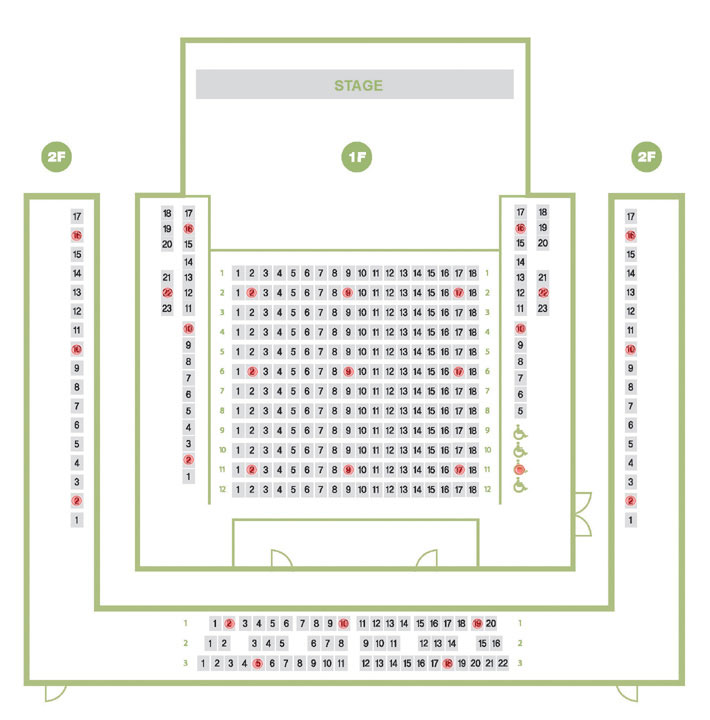
Total seats 354
- General seats350
- Accessible seats4
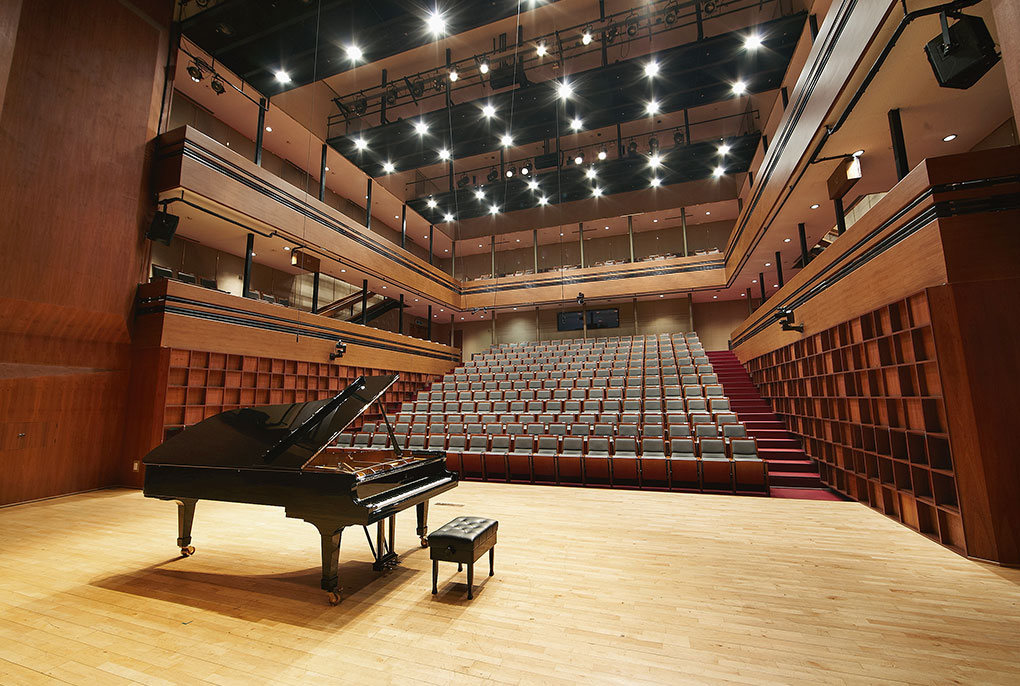
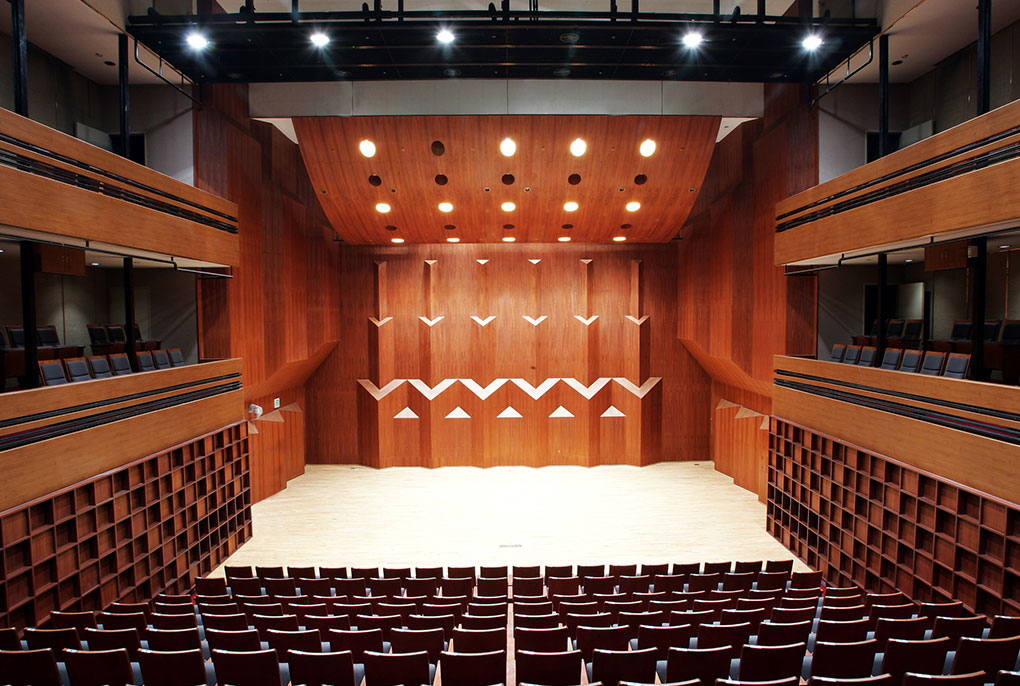
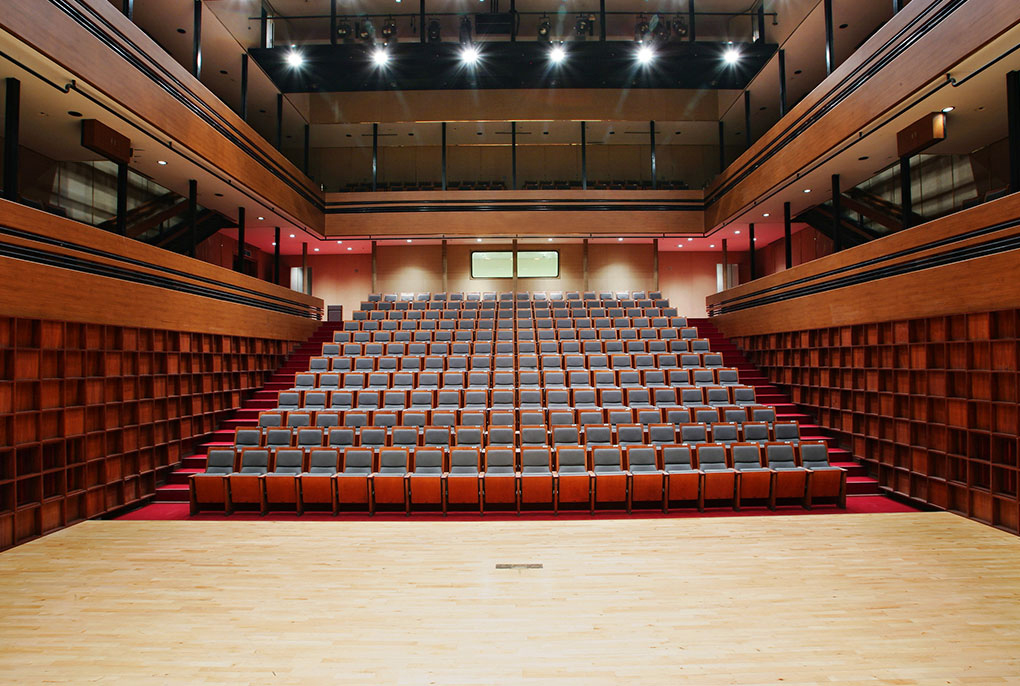
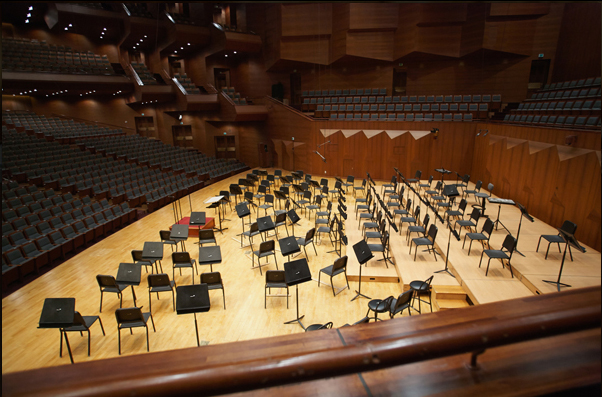
Recital Hallrecital hall with clear sound
The 2 stories 354 seats Recital Hall is the perfect venue for recitals that demand crystal clear sounds to resonate. It finished undergoing renovation in 2005 and has since been widely loved for showcasing debut and farewell stages, charming chamber music ensembles as well as experimental music.
Seating Charts
By clicking the seats circled in red in the seating chart,
you can see an actual view of the stage from your chosen seat.
-
1F 262 seats
- General seats 258
- Accessible seats4
-
2F 92 seats
- General seats92

All performances, except for children-specific ones, are suitable for elementary school students and older. If proof of age cannot be provided, entry will not be permitted regardless of ticket possession or accompaniment by a guardian. (Excluding performances aimed at children.)
We encourage travel by public transport because you may not be able to enter the venue before the performance start time due to parking lot congestion.
(ticket exchange or refund is not available for delays in entering the venue caused by parking lot congestion)
The maximum number of tickets allowed to be purchased per online order (pc, mobile) is 10. If you would like to purchase more than 10 tickets for a group, please call the Service Plaza (1668-1352)
Lost tickets are non-refundable or non-exchangeable as tickets are value instrument papers
We are not responsible for the tickets by individual transactions other than purchase through specified ticketing system or Service Plaza
| Classification | Cancellation fee | Note | |
|---|---|---|---|
| 10 days before the event | No charge | ||
| 9 days to 1 day before the event | 10% of paid amount | In case of tickets purchased up to 3 days before the performance, there will be no cancellation fee if cancelled on the day of the purchase (call: ~20:00 / visit Service Plaza: ~20:00(Tue~Sun), ~18:00(Mon) / homepage or mobile: ~23:59) |
|
| On the day of the event | Seoul Arts Center’s planned event | 90% of paid amount | 2 hours before the event starts (Non refundable at Box Office) |
| Rental event | Non refundable | 1 day before the event | |
※ Cancellation Fees for Exhibition Tickets:
- Tickets with Time Slots: Cancellation fees apply according to the same standards as for rental performances at the Seoul Arts Center
- General Exhibition Tickets: There is no cancellation fee until 7 days after ticket purchase, and a 10% cancellation fee is charged from the 8th day onwards.
 Credit card (or check card)
Payable up to the event day
- * Homepage(PC/Mobile)
- * Box Office
- * Service Plaza (Information & Tickets)
 Virtual account
Payable up to 5 days before the event day
- * Homepage(PC/Mobile)
Refund by payment methods ※ A refund is only possible with the same payment method as used in booking
- Credit card (or check card)
Approval cancellation by credit card company
- * Within 4 to 5 days from the requested date
- * Under the rules of refund by relevant credit card company
- * Cancellation fee will be charged to customer’s credit card
- Virtual account
Refund to the account in the name which the reservation is made in
- * Within 2 working days from the requested date
- * Refund after deducting cancellation fee
 Booking online
To cancel a reservation, a customer can check the reservation details in My Page on the website or through Service Plaza (1668-1352)
 Phone booking
To cancel a reservation, a customer can check the reservation details in My Page on the website or through Service Plaza (1668-1352).
 If a customer received booked tickets through visiting Service Plaza or mail delivery.
A customer must return tickets to Service Plaza until one (1) day before event day to get a refund. (Service Plaza Operating Times : Mon 09:00~18:00 / Tue~Sun- 09:00~20:00)
-
※ Partial Cancellation
- Partial Cancellation is allowed EXCEPT FOR the tickets paid by gift card, and special offer like ‘buy one get one free’ ticket. For more information and inquiry, please call Service Plaza (1668-1352)
 Box Office
- * Ticket pickup at venue on the event day
- * It operates one and a half hours prior to the start of a performance through its intermission
- * Without a break, it operates until 30 minutes after the start of the performance
 Service Plaza
- * Located in the Vitamin Station
- * Operating Times : Mon 09:00~18:00/Tue-Sun 09:00~20:00 (All the year around)
- * Inquiry: 1668-1352
- * Not for tickets booked through other ticket agency’s sales channel
 Ticket Delivery
- * Mail delivery request: available only for a ticket booked no later than 2 weeks (14 days) before event day
- * Delivery charge: prepayment KRW 3,700 per delivery
- * Time it takes a ticket to arrive: within 5 working days from mail delivery request
 Note for receiving a ticket
- Customers who have benefited from discounts (e.g. discount coupons and membership discounts, special discounts for the disabled, national merits, SAC Teens, noble members, students, seniors and last-minute tickets) must be able to present proof of eligibility when collecting discounted tickets. If a customer fails to present such certification, he or she must pay for the full ticket price to enter the venue.
- The Box Office is very crowded when an event is about to begin. We strongly recommend collecting your ticket at least 30 minutes before the performance starts.